One proprietary low-temperature process converts end-of-life tires into tread-grade carbon black, high-aromatic oil, and self-generated process gas, with zero waste streams.
Waste on one side. Carbon demand on the other.
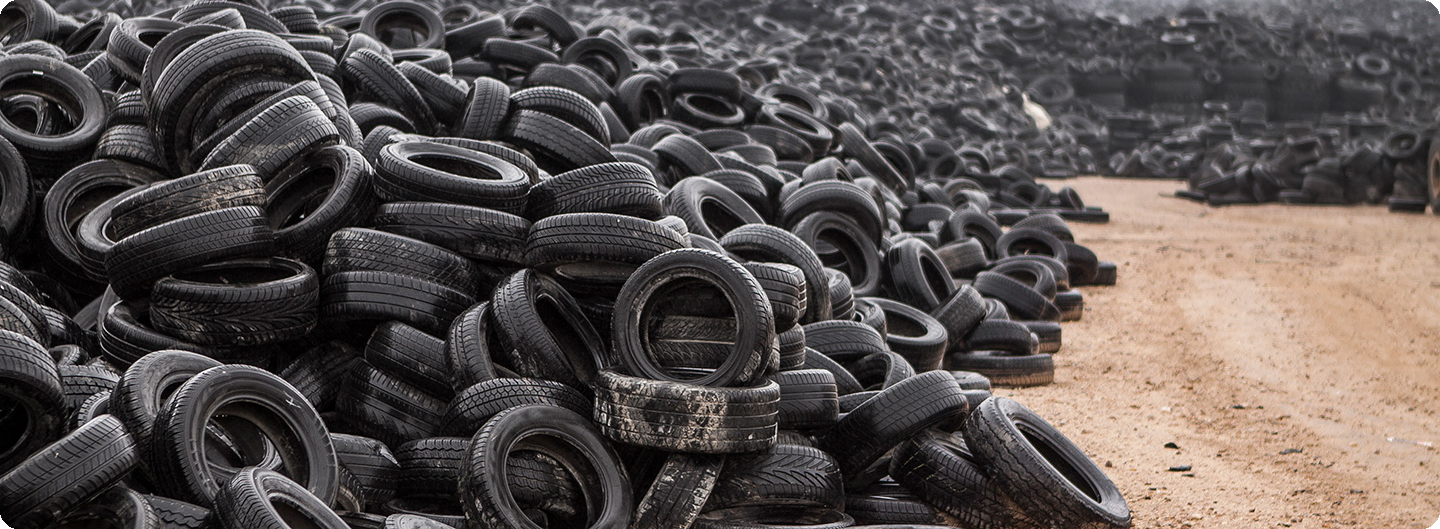
The world cannot absorb the tires it discards. More than 4 billion end-of-life tires sit in stockpiles, with roughly 1.5 billion more added every year. Most are landfilled, stockpiled, or burned as low-grade fuel.
At the same time, demand for industrial carbon keeps climbing. The carbon black bound up in a tire is the same material new tires are built from, and conventional recovery rarely returns it at usable grade.
TiPs treats a scrap tire as what it is: a carbon carrier. It recovers the materials the tire already contains and returns them as saleable product.
The gap between what a scrap tire contains and what the market pays for carbon is the opportunity.
4B+ End-of-life tires stockpiled globally, with ~1.5 billion more added every year.
~14M Tonnes of carbon black demanded globally each year, mostly tread-grade N330.
~4B Tonnes of cement produced each year, a vast market for affordable bulk carbon.
85-95% Aromatic content of the recovered diluent, a high-value solvent and fuel.
Nothing is wasted.
Every tonne of crumb rubber separates into three saleable streams. Select a stream to see where it goes.
Carbon black · 40% Fuel oil & diluent · 45% Process gas · 15%
Carbon black · 40%
Tread-grade N330 carbon black, validated against virgin material and sold back into tire manufacturing in a closed tire-to-tire loop.
Use cases
- Tires, belts, and rubber goods
- Advanced concrete
- Metallurgical carbon for steel
- Soil and agriculture
Size of the industry
- Global carbon black demand is about 14 million tonnes a year, a market worth more than $20B.
- About 4 billion tonnes of cement are produced each year, a vast outlet for affordable bulk carbon.
Fuel oil & diluent · 45%
High-aromatic oil, 85 to 95% aromatic content, plus a 200+ constituent solvent with naturally occurring d-limonene.
Use cases
- Industrial heating
- Marine and bunker fuel
- Refining feedstock
- Diluent blending
Size of the industry
- The global fuel oil market is worth roughly $190B a year.
- Marine shipping alone burns more than 300 million tonnes of bunker fuel a year.
- The d-limonene solvent market alone is worth about half a billion dollars a year.
Process gas · 15%
Non-condensable gas captured during processing. It powers the TiPs unit and crumb drying in a closed loop.
Use cases
- Powers the TiPs unit
- Runs feedstock drying
- Closed loop after startup
- Zero external fuel
Size of the industry
- Not sold: it replaces purchased fuel, so the plant runs with zero external fuel after startup.
Typical recovered output per tonne of crumb rubber. Passenger and light-truck tires are consistent, so the split holds well from project to project. Independently validated by Sid Richardson Carbon Co, a division of Tokai Carbon (Japan): comparable cure behavior, strong tensile and elongation, and equal or better abrasion resistance than the N330 control.
How TiPs compares
End-of-life tires have an incumbent disposal route. TiPs replaces all of them with material recovery instead of destruction.
| TiPs | Pyrolysis | TDF (tire-derived fuel) | Landfill / stockpile | |
|---|---|---|---|---|
| Process | Sealed, low-temperature thermal mechanical depolymerization under vacuum. | High-temperature thermochemical cracking, 400 to 800°C. | Whole or shredded tires burned as fuel in cement kilns and boilers. | No processing. Whole or shredded tires buried or stockpiled. |
| Products | Carbon, fuel oil, process gas, recovered solvent. | Fuel oil, low-grade char, syngas. | Heat only. The carbon and oil are lost to combustion. | None. The material value is lost. |
| Material value | Preserved and sold into product markets, including N330. | Partially destroyed, lower-value byproducts. | Destroyed in combustion. | Stranded and lost. |
| Environmental | Zero waste streams, no combustion in the process. | Energy-intensive, char disposal issues. | Stack emissions and ash. Displaces coal, but burns the material. | Fire risk, leaching, and vector breeding. |
| Deployment | Modular, distributed, on-site at the supply. | Large centralized plants. | Burned in existing kilns and power boilers. | Permanent land use and long-term liability. |
44 t/day Processed per processor on continuous feed at full scale (48 short tons).
TRL 8 Technology readiness proven across 10,000+ hours of full-scale operation.
Modular Processors are added as feedstock and demand grow. No giant central plant required.
Take the full project with you.
SENS delivers waste-to-value solutions at scale. Whether you represent an investor, a manufacturer, a municipality, or a fund, we invite you to explore what TiPs can do with end-of-life tires in your region.
SENS · End-of-Life Tires Full project brochure, including the project economics (PDF)