
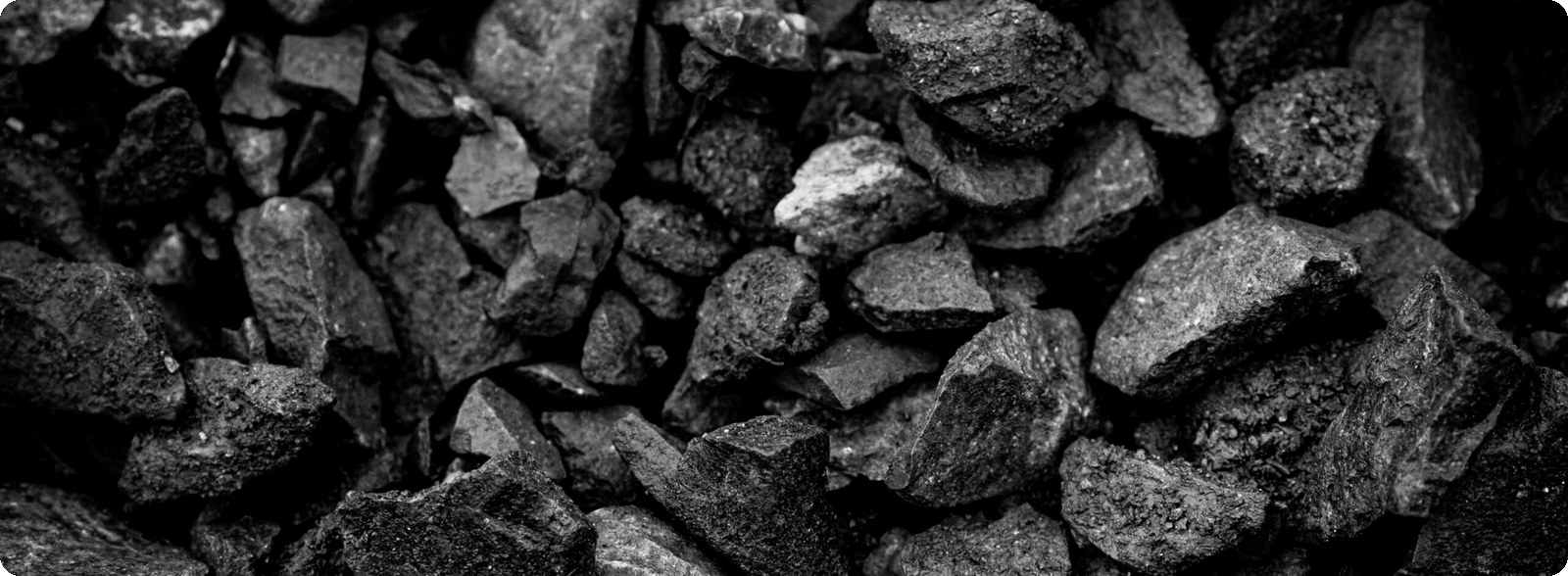
One proprietary low-temperature process converts run-of-mine coal into solid industrial carbon, fuel oil, and process gas, before combustion, with the carbon sold as a material instead of burned.
Security of supply on one side. Carbon demand on the other.
Burning raw coal destroys everything of value in it. The carbon that gives coal its energy is also a strategic industrial material, and once it is combusted, that value is gone for good.
Demand for industrial carbon keeps climbing across concrete, steel, agriculture, and energy storage. Conventional carbon-black pricing keeps many of these uses as research only.
TiPs converts coal into a solid carbon material at a modeled $0.22/kg ($0.10/lb), far below market. Cheap carbon makes whole new markets economically viable.
The gap between the carbon coal contains and what the market pays for it is the opportunity.
$0.22/kg Modeled carbon selling price ($0.10/lb), far below the carbon-black market.
~4B Tonnes of cement produced each year, a vast market for affordable bulk carbon.
190M Tonnes of fertilizer applied each year. Carbon helps soil hold water and nutrients.
368K t Tonnes of industrial carbon each year (406,000 short tons) from a single six-processor line.
Nothing is wasted.
Every tonne of coal separates into five saleable streams. Choose a coal type to see how the split shifts, then select a stream to see where it goes.
Coal type
We understand coal composition varies by region and seam; these are modeled averages by rank.
Carbon · 46% Fuel oil · 23% Mineral ash · 14% Water · 8% Process gas · 9%
Carbon · 46%
Solid industrial carbon at a modeled $0.22/kg ($0.10/lb), priced to open markets that conventional carbon-black pricing kept as research only.
Use cases
- Advanced concrete
- Metallurgical carbon for steel
- Soil enrichment and agriculture
- Activated carbon
Size of the industry
- About 4 billion tonnes of cement are produced each year, a vast outlet for affordable bulk carbon.
- Steelmaking consumes more than 500 million tonnes of metallurgical coke a year, a market clean carbon can enter.
- About 190 million tonnes of fertilizer are applied each year; carbon helps soil hold water and nutrients.
Fuel oil · 23%
High-aromatic coal-fuel-oil, about 184,000 tonnes a year from one six-processor line.
Use cases
- Industrial heating
- Marine and bunker fuel
- Refining feedstock
- Diluent blending
Size of the industry
- The global fuel oil market is worth roughly $190B a year.
- Marine shipping alone burns more than 300 million tonnes of bunker fuel a year.
Mineral ash · 14%
Mineral ash stays entrained in the carbon for concrete and agriculture, with cyclone separation available for higher-grade buyers such as steel.
Use cases
- Cement and concrete
- Aggregate
- Higher-grade separation for steel buyers
Size of the industry
- Supplementary cementitious materials are a global market worth more than $17B a year.
Water · 8%
Moisture bound in the feedstock, captured during processing and recovered as clean water instead of vented as steam. It rises sharply with lower-rank coals like lignite.
Use cases
- Recovered as clean water
- Returned to the process loop
- Dust and site control
- Cuts net freshwater draw
Size of the industry
- Lignite can carry 30 to 40% moisture as received, so recovered volume scales with rank.
- A closed loop returns recovered moisture rather than drawing from local supply.
Process gas · 9%
Non-condensable gas captured during processing. It powers the plant and upstream drying.
Use cases
- Powers the plant
- Runs feedstock drying
- Closed loop after startup
- Zero external fuel
Size of the industry
- Not sold: it replaces purchased fuel, so the plant runs with zero external fuel after startup.
Modeled average product split by coal rank. Process gas stays roughly constant; carbon, fuel oil, mineral ash, and moisture shift with the seam. Independently validated on tire feedstock by Sid Richardson Carbon Co, a division of Tokai Carbon (Japan); a feedstock-specific assay is completed for each project.
How TiPs compares
Coal has an incumbent route: combustion. TiPs replaces it with material recovery before any carbon is burned.
| TiPs | Pyrolysis | Raw coal combustion | Raw coal + bolt-on CCS | |
|---|---|---|---|---|
| Process | Sealed, low-temperature thermal mechanical depolymerization under vacuum. | High-temperature thermochemical cracking, 400 to 800°C. | Raw coal burned directly in a boiler, 850°C and above. | Raw coal combustion with CO2 capture bolted on. |
| Products | Carbon, fuel oil, process gas, mineral ash. | Fuel oil, low-grade char, syngas. | Heat and power, with fly ash and bottom ash. | Power, plus captured CO2 at high cost. |
| Material value | Preserved and sold into product markets. | Partially destroyed, lower-value byproducts. | Destroyed in combustion. | Destroyed in combustion. |
| Environmental | Zero waste streams, no combustion in the process. | Energy-intensive, higher emissions. | Fly ash, NOx, SOx, and particulate emissions. | Regulated pollutants remain, capture is costly. |
| Deployment | Modular, distributed, on-site at the mine. | Large centralized plants. | Large centralized plants. | Large capture plant per facility. |
800K t/yr Coal processed on one mine-mouth line across six TiPs processors (882,000 short tons).
TRL 8 Technology readiness proven across 10,000+ hours of full-scale operation.
Modular Processors are added as feedstock and demand grow. No giant central plant required.
Take the full project with you.
SENS delivers clean carbon solutions at scale. Whether you represent a mining operator, a government, a materials buyer, or an investment fund, we invite you to explore what TiPs can do with coal in your region.
SENS · Coal to Clean Carbon Full project brochure, including the project economics (PDF)